

In a landmark observation with nationwide implications, the Federal Ombudsperson for Protection against Harassment of Women at the Workplace (FOSPAH) has ruled that any policy or practice denying residential accommodation to bachelor men or women is illegal, discriminatory, and void ab initio, as it has no basis in Pakistan’s tenancy laws or constitutional framework.
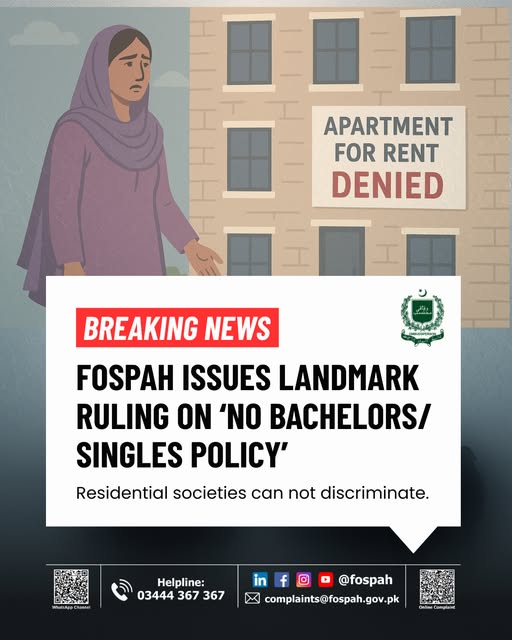
The ruling emerged from a complaint filed by Ms. Sana Humayun Khan, a working woman employed with a national media organization, who reported sustained harassment, coercive behavior, and discriminatory pressure by the management of a private residential building in Islamabad. Despite living peacefully with her sister and fully complying with the terms of her tenancy, she was repeatedly told that “bachelors cannot live here.”
FOSPAH took serious notice of allegations that electricity and water supplies were disconnected to pressure Ms. Khan into vacating the premises, and that informal, unwritten “policies” rooted in gender stereotypes were being enforced without any lawful authority. While the individual dispute was resolved after assurances from the building management, the Forum deemed it necessary to address the wider, systemic discrimination faced by working women and unmarried professionals across urban Pakistan.
In a strongly worded observation, FOSPAH held that marital status or gender-based bachelorhood is not a lawful ground to deny residence. The Forum warned that such practices violate fundamental constitutional principles of equality, dignity, and freedom of residence. It emphasized that mobility is a necessity rather than a privilege, particularly for women whose employment opportunities are often concentrated in major cities.
Significantly, FOSPAH acknowledged that housing insecurity can directly affect women’s professional lives. It noted that discriminatory residential practices, especially when enforced through intimidation or misuse of authority, may fall within the scope of scrutiny under the Protection against Harassment of Women at the Workplace Act, 2010.
In its formal observation, the Forum stated:
“No tenancy agreement, housing regulation, or governing statute in Pakistan recognizes marital status or gender-based bachelorhood as a lawful ground to deny residence. Any such restriction, whether written or unwritten, is manifestly arbitrary, discriminatory, and void from its inception.”
The observations have been forwarded to federal and provincial authorities, rent controllers, housing regulators, local governments, and other housing-sector stakeholders, with directions for immediate alignment of policies and compliance. FOSPAH cautioned that informal practices presented as “policy” cannot override constitutional guarantees.
Reaffirming its commitment to a harassment-free, dignified, and inclusive Pakistan, FOSPAH stressed that practices rooted in moral policing or gender stereotypes are incompatible with a modern, rights-based society. The Forum underscored that no woman should be forced to choose between her livelihood and her dignity.
Although the complaint filed by Ms. Khan was disposed of as settled, the ruling is expected to have far-reaching implications for landlords, housing societies, property managers, and regulators across the country.