
ISLAMABAD: At a time when ordinary citizens often feel overwhelmed by complex government machinery, the Wafaqi Mohtasib Secretariat has reaffirmed its role as a vital bridge between the state and the people, delivering free, speedy, and effective justice against maladministration across Pakistan.
Established on January 24, 1983, under President’s Order No. 1 in line with Article 37(d) of the Constitution, the Wafaqi Mohtasib was created to ensure inexpensive and swift justice. More than four decades later, its performance in 2025 reflects a remarkable transformation into a citizen-centric, digitally empowered institution of accountability.
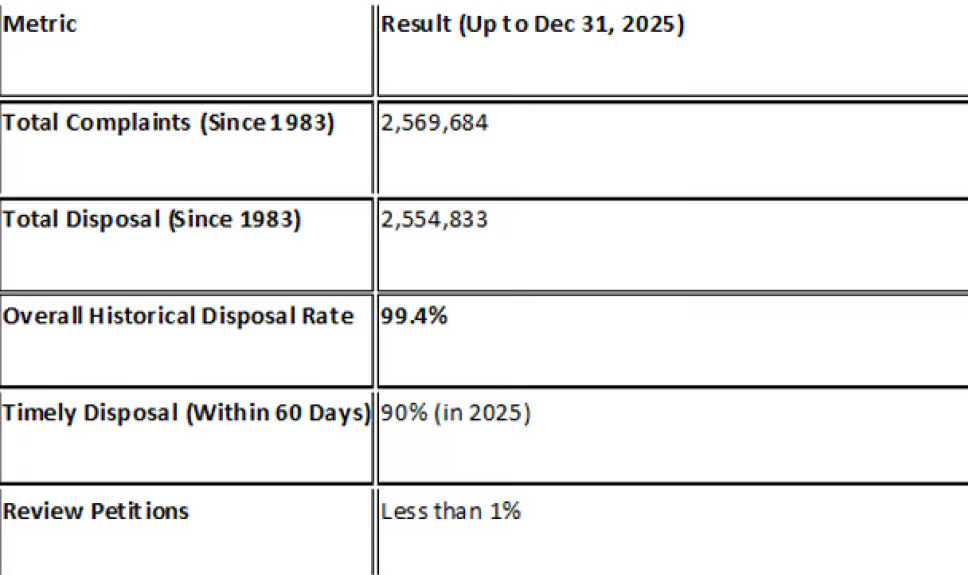
Under the leadership of Federal Ombudsman Ejaz Ahmad Qureshi, the institution reached an unprecedented level of public trust and efficiency. In 2025 alone, the Secretariat received 256,688 complaints, showing a 13 percent increase from the previous year, while disposing of 261,101 cases, including backlog, a 17 percent rise in efficiency compared to 2024. Nearly 90 percent of cases were resolved within the legally prescribed 60 days.
The financial impact of these decisions was equally significant, with disputed amounts totaling Rs. 10.21 billion, up from Rs. 8.22 billion in 2024. The implementation rate of the Ombudsman’s decisions also reached a historic high of 96.8 percent, reflecting strong institutional authority and compliance by federal agencies.
The jurisdiction of the Wafaqi Mohtasib now spans over 639 federal organizations, with 213 fully integrated into the Complaints Management Information System (CMIS), enabling real-time tracking and transparent resolution of grievances. Nearly half of all complaints in 2025 were filed through online portals and the mobile application, making justice accessible even to citizens in remote areas.
Specialized complaint mechanisms further strengthened inclusivity. During the year, 137,152 complaints from overseas Pakistanis were addressed, while a dedicated children’s grievance cell handled 683 cases through Helpline 1056. A business grievance redressal mechanism, developed in coordination with Chambers of Commerce, also contributed to improving the investment and trade environment.
Beyond individual relief, the institution continued to drive systemic reforms. To date, 84 research-based systemic studies have been conducted, covering areas such as jail reforms, pension issues, primary healthcare, judicial cooperation, and the protection and rehabilitation of street children in Islamabad. A high-level advisory committee regularly identifies quick-win reforms to improve public service delivery.
The principle of “Justice at the Doorstep” remained central to operations. In 2025, 166 Khuli Katcheries (open courts) were held nationwide, while Outreach Complaint Resolution (OCR) teams visited remote areas 232 times, resolving more than 6,000 complaints on the spot. New regional offices were established in Kharan, Khuzdar, Mirpur Khas, Sadda, Wana, Sibbi, and Gilgit-Baltistan, with additional offices fully functional in AJK, D.G. Khan, Sahiwal, and Larkana.
The Wafaqi Mohtasib also strengthened public awareness, generating over 12,000 outreach touchpoints through print, electronic, and social media. Surveys revealed that 81 percent of the public is now aware of the institution’s services, while 96 percent of complainants expressed satisfaction with the complaint process.
Internationally, Pakistan’s Ombudsman institution continues to serve as a benchmark for administrative justice. The Federal Ombudsman of Pakistan was re-elected unopposed as President of the Asian Ombudsman Association on September 11, 2023, underscoring Pakistan’s leadership role in the global ombudsman community and its alignment with the UN Sustainable Development Goal 16 on peace, justice, and strong institutions.
As Pakistan moves forward, the Wafaqi Mohtasib stands as a powerful symbol of good governance and rule of law, proving that justice can be swift, cost-free, and effective when institutions place citizens at the center of their mission.
For public assistance, citizens may contact the Federal Ombudsman through Helpline 1055, Children’s Helpline 1056, or visit www.mohtasib.gov.pk.